Foreword
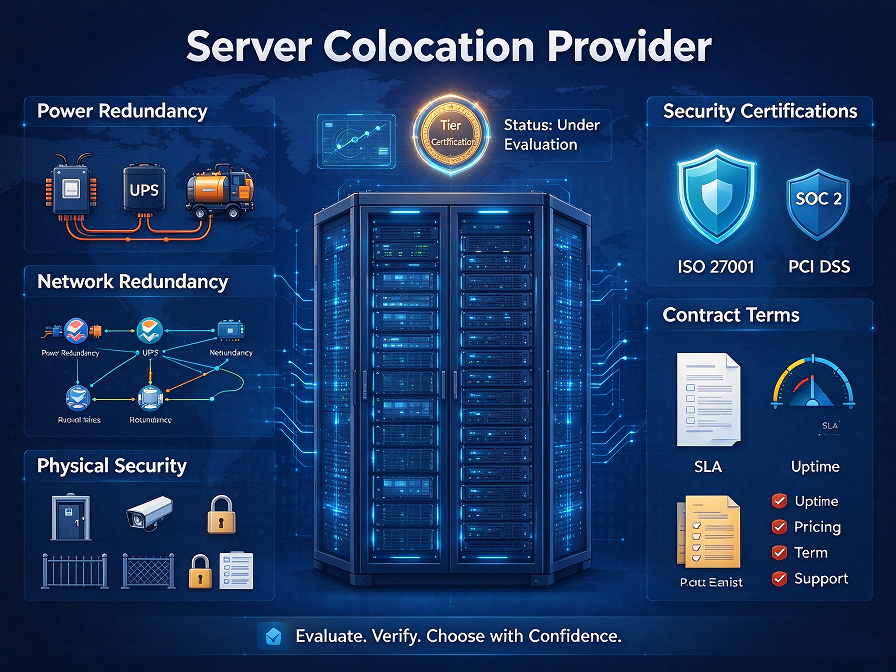
Selecting a server colocation provider is not a decision that can be reversed cheaply. Once workloads are deployed and network routes are established, migration costs are significant. Yet many organizations evaluate providers using the same criteria they would apply to a cloud service: price per rack, bandwidth allocation, and a quick tour of the facility. That approach misses the dimensions that determine whether the provider can actually deliver on its promises. This article will analyze server colocation providers from five evaluation dimensions, along with the specific metrics and contract terms that separate a well-run provider from one that merely markets well.
Tier Certification
The Uptime Institute Tier Classification System is the dominant industry standard for data center infrastructure performance. However, the certification status matters as much as the tier level itself. The Uptime Institute awards certification at three distinct stages:
Tier Certification of Design Documents (TCDD): Confirms the design drawings meet the tier requirements.
Tier Certification of Constructed Facility (TCCF): Verifies the facility as built and commissioned meets the standard.
Tier Certification of Operational Sustainability (TCOS): Assesses whether the site is operated in a way that sustains the tier over time.
A provider advertising “Tier III design certified” holds certified paperwork, not necessarily a certified building. The constructed-facility certification is the stronger claim. Providers using softer language such as “Tier III equivalent,” “Tier III standards,” or “built to Tier III” are making self-assessments, not certifications.
The practical difference between Tier III and Tier IV comes down to planned versus unplanned failure:
Tier III: The facility is concurrently maintainable. Any component can be taken offline for maintenance without interrupting IT operations.
Tier IV: The facility adds fault tolerance. Even an unplanned failure of any single component or distribution path does not affect the IT load.
Tier III promises maintenance without downtime, while Tier IV promises both maintenance and single-failure survival without downtime.
For most enterprise workloads, a well-operated Tier III facility paired with application-level resilience can deliver strong real-world availability. Tier IV is justified where the cost of downtime exceeds the premium: financial trading systems, regulated workloads, and single-site deployments with no failover option.
Power Redundancy
Power topology is the foundation of facility reliability. The shorthand terms describe capacity and redundancy, and confusing them can mean a six-figure design change.
N represents the minimum capacity to support the load. N+1 adds one additional unit beyond minimum, so one is redundant. 2N means fully duplicated systems on separate distribution paths. 2N+1 adds a spare to the fully duplicated setup.
Tier III generally requires N+1 with multiple distribution paths, but only one active at a time. Tier IV requires 2N with both paths active and physically separated, typically through compartmentation walls with a minimum two-hour fire rating.
During evaluation, ask the provider for the exact redundancy configuration for power and cooling. Then verify the fuel storage duration. Tier III requires a minimum of 72 hours of fuel storage; Tier IV requires 96 hours. The difference matters during extended grid outages.
Network Redundancy
Network redundancy determines whether a single ISP failure can take your workloads offline. Server colocation providers achieve WAN redundancy through multiple connections and Border Gateway Protocol (BGP) routing.
The configurations range from single-homed (one ISP, no redundancy) to dual-homed (one ISP with multiple links) to single multi-homed (multiple ISPs with one link each). A well-designed enterprise colocation environment typically uses multi-homed configurations, where BGP detects network failures and reroutes traffic between ISPs automatically.
During evaluation, ask the provider how many ISP peers they connect to, whether they advertise your IP block across multiple upstreams, and whether the BGP configuration is single multi-homed or dual multi-homed. A provider that connects to only one ISP, even with multiple links, still has a single point of failure at the provider level.
Security and Compliance Certifications
Security certifications provide independent verification that the provider’s operational practices meet recognized standards. The most relevant certifications for colocation evaluation are ISO 27001 (information security management), SOC 2 Type II (security and availability controls), and PCI DSS (payment card industry).
ISO 27001 evaluates whether the data center operates a complete Information Security Management System (ISMS), covering physical security, patch management, access control, incident management, and business continuity. An ISO 27001-certified facility does not automatically make the customer GDPR-compliant, but it significantly simplifies the customer’s own compliance evidence.
SOC 2 Type II is particularly relevant for cloud and SaaS environments hosted in colocation facilities. It reports on the effectiveness of security controls over a period of time, not just at a point in time.
During evaluation, request the certification scope, the date of the most recent audit, and whether the certification covers the specific facility you are considering. Certifications are issued per facility, not per company.
SLA and MTTR
The Tier level itself does not go into the contract. The terms derived from it do. The Service Level Agreement (SLA) should specify guaranteed availability and how it is measured, the planned-works procedure, compensation mechanics for unavailability, committed power per rack, cooling scheme, and remote hands response times.
Mean Time To Repair (MTTR) is a critical SLA metric. Industry-standard MTTR for colocation services ranges from four hours for critical issues to 32 hours for minor issues, depending on the provider. Some providers commit to an eight-hour standard MTTR for fault restoration.
Power and HVAC availability SLAs typically guarantee 100% availability in a given month, with service credits of five percent of the monthly recurring charge for each hour of downtime.
During evaluation, compare the MTTR commitments across providers and confirm the escalation path and communication channels. A 24/7 phone line is not the same as a 24/7 engineering response team.
Pricing Transparency
Pricing opacity is one of the most common sources of post-contract friction in colocation agreements. The evaluation should cover the full cost structure, not just the rack rate.
Key items to clarify:
Whether power is billed at a flat rate or metered.
Whether cross-connects carry monthly recurring charges.
Whether remote hands are included or billed hourly.
Whether bandwidth commits are measured at 95th percentile or peak.
Expansion costs: if you need additional racks or power later, what is the pricing mechanism?
Providers that publish clear pricing structures and offer online calculators tend to be more transparent in their contracts. During evaluation, ask for a sample invoice from an existing customer (anonymized) to see the actual line items beyond the headline rate.
Evaluation Checklist
Use the following checklist to structure the provider evaluation:
Tier certification status: Is the facility TCDD-certified, TCCF-certified, or TCOS-certified? Request the certification documents.
Power redundancy: Confirm the exact configuration (N+1, 2N, or 2N+1) and fuel storage duration (72 or 96 hours).
Cooling redundancy: Verify the cooling scheme and whether continuous cooling is provided.
Network redundancy: Confirm the number of ISP peers and the BGP configuration (single multi-homed or dual multi-homed).
Security certifications: Verify ISO 27001, SOC 2 Type II, and PCI DSS certifications for the specific facility.
Physical security: Access controls, biometric verification, video surveillance, and compartmentation.
SLA terms: Guaranteed availability percentage, measurement methodology, and service credit structure.
MTTR commitment: Standard repair time for critical, major, and minor issues.
Remote hands response: Response time commitment and escalation path.
Pricing structure: Power billing, cross-connect charges, remote hands fees, and bandwidth measurement method.
Expansion pricing: Cost of additional racks, power, and bandwidth.
Reference customers: Ask for anonymized invoices and customer references in similar workload profiles.
Summary
Evaluating a server colocation provider requires looking beyond the headline tier label and rack rate. The certification status matters as much as the tier level. Power and network redundancy determine whether a single failure can take you offline. Security certifications provide independent verification of operational practices. The SLA and MTTR commitments define what the provider is actually obligated to deliver. Pricing transparency determines whether the total cost matches the quoted cost.
A structured evaluation across these dimensions takes more time upfront but reduces the risk of discovering gaps after workloads are already deployed.
Thank you very much for reading to the end!